Minerbird Energy
New Initiative: Modular Mini Refinery — Northwest Western Australia
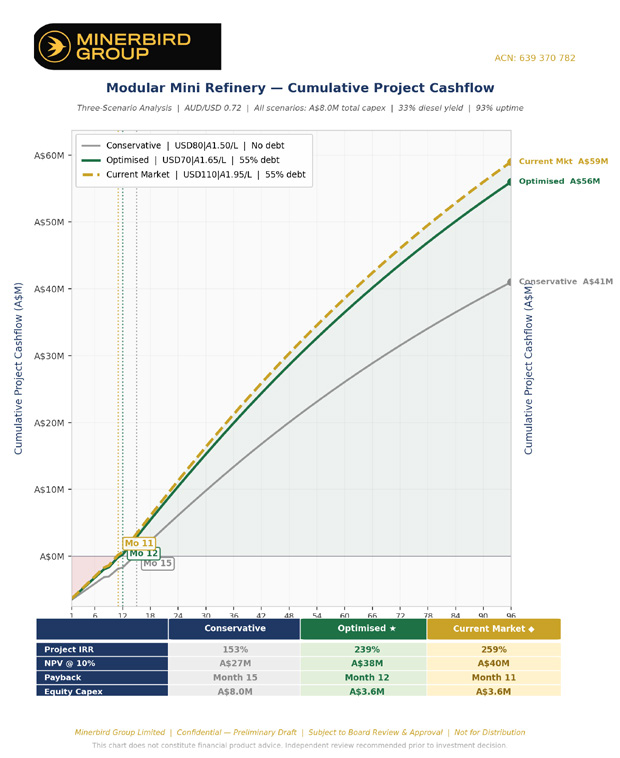
Minerbird Group Energy (MGE) is advancing a 500 BOPD modular mini refinery project in northwest Western Australia, co-located with an established sweet crude oil field operated by a listed WA oil and gas producer. The integrated upstream–downstream model captures value at both ends — converting sweet crude into refined product worth more than 250% of its wellhead value, while eliminating third-party transport and feedstock risk. Financial modelling across three oil price scenarios (Conservative USD$80, Optimised USD$70, Current Market USD$110) consistently demonstrates compelling project economics — project IRR ranging from 153% to 259%, NPV of A$27M–A$40M, and payback within 11–15 months. Total project capex is A$8.0M; with 55% senior debt the equity requirement reduces to A$3.6M.
The Opportunity
In late 2024, Minerbird Group identified an opportunity to participate in the marketing and sale of sweet light crude oil from an established northwest WA oilfield. MGE engaged Greg Lee, a petroleum engineer with over 40 years of industry experience, to assess the viability.
Early commercial and technical analysis revealed a more compelling value proposition: rather than selling crude at wellhead, processing it through a co-located modular refinery transforms the same barrel into refined product commanding a 250%+ price premium. The economics were compelling enough to warrant a full pre-feasibility study, which
confirmed both technical and financial viability.
The Project
MGE proposes a 500 BOPD modular refinery located in northwest Western Australia, physically co-located with the producing oilfield. MGE is also seeking up to 70% equity in the upstream crude supply, creating a vertically integrated operation with direct feedstock control. Co-location eliminates crude transport costs, removes third-party supply risk, and compresses the margin stack in MGE’s favour.
The refinery utilises a well known and established company that already design modular systems incorporating a Forced Circulation Evaporator, Pre-Flasher, and Short Path Evaporator — a proven configuration delivering efficient separation, energy recovery, and operational simplicity. All major components are fabricated to Australian Standards with
a distributed control system enabling remote monitoring and management. The modular design allows incremental capacity expansion without major capital reinvestment.
Delivery is structured as a modular EPC contract, minimising on-site labour, containing cost overruns, and de-risking commissioning. The selected company has a demonstrated track record of delivering modular facilities in Australia.
The Upside – A Platform, Not Just a Project
MGE has identified over a dozen suspended oilfields in Australia that are shut in due to prior low oil prices, the logistics of crude transport to refinery, and base economics. These fields have proven reserves and are near end-point diesel users and transport and other infrastructure, such that a MGE modular refinery will enable these proven fields to become economically viable.
Given Australia’s current weakness in the energy sector, the demonstrated failure of the renewable transition to address transport fuel demand, and the country’s utter reliance on diesel to move goods and on imported refined oil products, this presents a unique strategic opportunity. MGE’s modular platform is replicable, scalable, and directly addresses a national supply vulnerability.
MGE has engaged on several occasions with the WA Mines Minister and his staff for preliminary discussions on potential government support. The Minister was confident MGE would qualify under the NAIF (Northern Australia Infrastructure Facility) scheme that the Commonwealth and State governments provide for the northern regions of Australia. Government co-investment would materially enhance project returns and validate the strategic rationale.
The Economics – Three Scenario Summary
The table below presents three scenarios. All scenarios use a consistent AUD/USD rate of 0.72 and identical production and operational assumptions. Diesel pricing is linked to the oil price scenario to reflect real-world market correlation. The corrected financial model properly reflects MGE’s 70% equity position in the field.

Optimised: USD$70 Brent with A$1.65/L diesel (remote WA contracted offtake), 55% senior debt (NAIF-eligible), 33% yield, 93% uptime.
Current Market: USD$110 Brent with A$1.95/L diesel (current remote WA pricing), same debt and operational structure. Best-case scenario under today’s conditions.
Even the Conservative case (USD$80 Brent, no debt, no remote premium) returns a 153% project IRR and full payback within 15 months.